
What is Generative Engine Optimization (GEO) and how does it work in 2026
Answer Engine Optimisation (AEO):
A Complete Guide
to Optimising Your Digital Content
The focus of AEO is to respond the users in a compact and comprehensive manner. Nowadays, no one has the time to go through multiple pages to search for answers. It is also a boon to the mobile users who prefer direct answers. Therefore, AEO provides a unique aspect to understand and deliver the right answer immediately.
Evolving in 2026 is changing the way digital search operates. As businesses
will need to adjust their business practices to ensure they remain visible as the AI-based answer
engines, then in 2026 AEO will be crucial to high rankings in AI-generated results.





UNDERSTANDING GEO, AEO, and SEO : How they’re connected
HOW AEO IS CONNECTED TO GEO AND SEO
GEO and AEO are not replacements for SEO! They are natural extensions of it. Research from Semrush shows that users who adopt tools like ChatGPT do not abandon traditional search; instead, their overall search activity expands. Traditional SEO remains critical because both generative and answer engines continue to rely on the same core signals that have always driven visibility: authority, relevance, clarity, and trust. These signals underpin how content is selected, interpreted, and surfaced across all modern search environments.

SEO
SEO remains the foundation with focus on crawl ability, technical performance, keyword alignment, and ranking visibility across traditional search engines like Google..
AEO
AEO extends SEO into an answer-first landscape, ensuring that content is structured, concise, and easily extractable so it can appear in AI-generated snippets, featured answers, and search overviews.

GEO
GEO builds on both by positioning content as a trusted reference, creating authoritative, citation. Worthy assets that large language models are more likely to reference.
Think of these as three interconnected layers: SEO establishes baseline discoverability, AEO ensures content is accessible and extractable in answer-driven environments, and GEO elevates that content to a level where it is consistently referenced by AI systems. Together, they form a unified strategy that ensures visibility across traditional search engines, conversational AI platforms, and generative answer engines.
Across all three layers, third-party validation remains a critical trust signal. External references, citations, and mentions reinforce credibility and helping content rank in traditional search, increasing the likelihood of inclusion in answer snippets, and improving the chances of being cited by AI systems.

Together, GEO and AEO give brands a framework for visibility in a world where AI engines are the starting point for discovery. Understanding the role of each approach is essential to building a marketing strategy that can adapt.
What is Answer Engine Optimization?
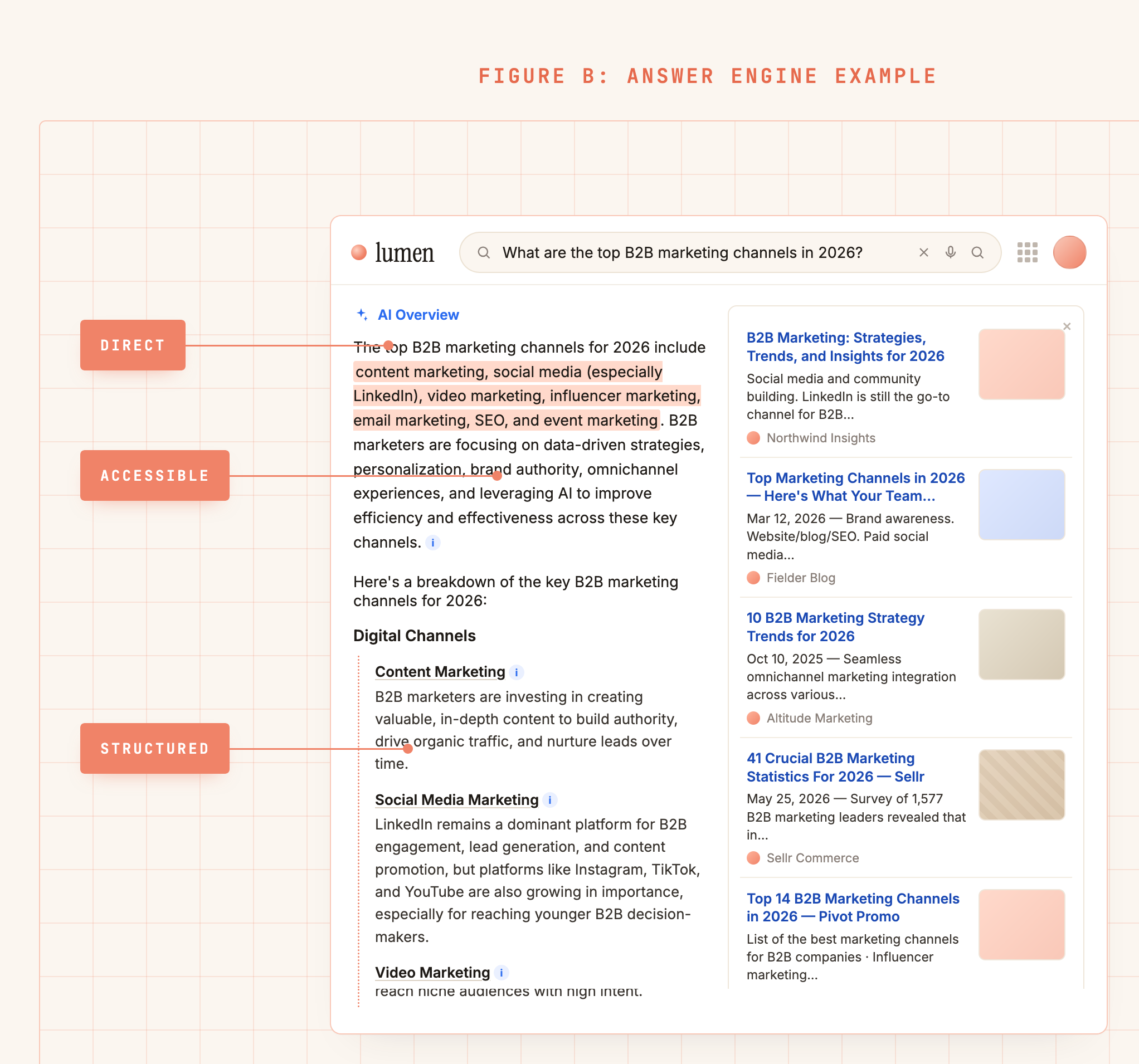
AEO is the practice of making your content clear and easy for AI systems to pull and provide the answers. AEO focuses primarily on intent and clarity. In other words, AEO deals with making sure your content directly answers a user’s question(s) in a conversational style. It’s about being THE answer, not just ranking near the answer.
Key AEO tactics include:
Directness: Anticipating user questions and answering them clearly in concise formats.
Structure: Using FAQs, lists, and tables that align with how engines extract and present information
Accessibility: Writing in plain, easy-to-parse language so engines don’t need to “translate” your content.
What is Generative Engine Optimization?
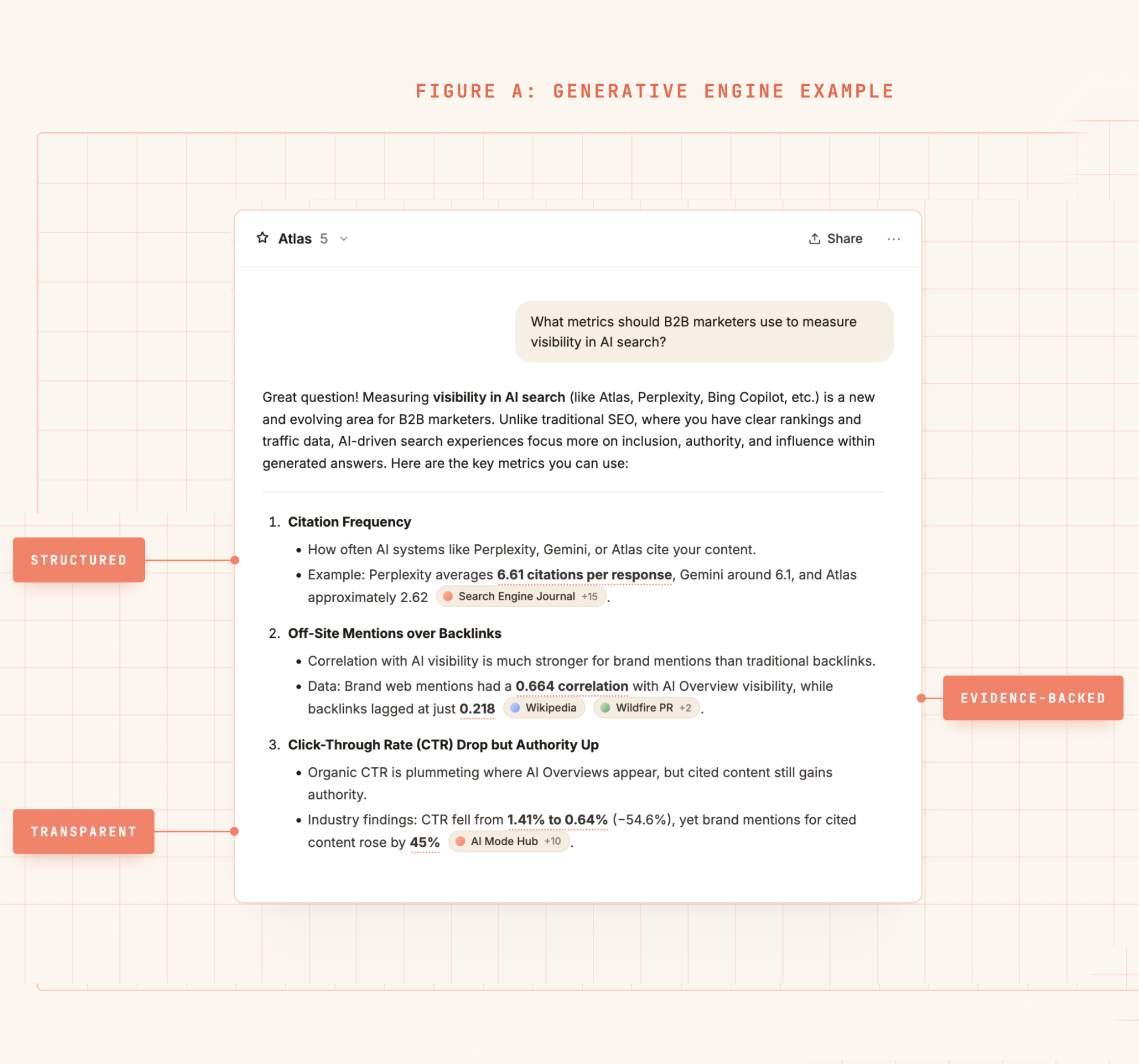
GEO is the practice of designing content so that LLMs like ChatGPT, Perplexity, Gemini, and Claude are more likely to cite it in their responses. Unlike traditional search engines that return a list of links, generative engines deliver synthesized answers, often built from multiple sources.
What does this mean in practice? GEO rewards content that is:
Evidence-Backed: Data, original research, verifiable statistics, and third-party validation are more likely to be used in generative outputs.
Structured: Schema markup, descriptive metadata, and well-organized content (with charts, tables, headings, and passages) help models parse and reuse information accurately.
Transparent: Clear authorship, citations, and data provenance signal credibility.
How to improve brand visibility in AI search engines



Step 1: Research and Intent Mapping
Every successful GEO and AEO strategy begins with understanding user intent at scale. Modern AI systems evaluate semantic relevance, contextual alignment, topical depth, and behavioral intent — not just keywords. As a result, research workflows must evolve beyond traditional keyword analysis into intent-driven content intelligence.
AI-native workflows now leverage LLMs and autonomous agents to rapidly analyze:
Search trends • Customer conversations • CRM notes • CRM notes • Support tickets • Community discussions • Competitor content • Social media interactions • AI-generated search responses
Cluster topics semantically
Use AI to group related entities, concepts, and search behaviors into meaningful topical clusters rather than isolated keywords.
Validate AI output with human oversight
AI accelerates research, but editorial review remains essential to ensure factual accuracy, strategic alignment, and content quality.
Map intent to content formats
Different intent types require different formats:
FAQs • Glossaries • Research reports • Guides • Case studies • Comparison pages • Tutorials • Interactive tools
Scale repetitive research processes with AI while focusing human expertise on differentiation, positioning, and authority building.
SEO vs GEO vs AEO: Key Differences Explained
This comparison highlights how traditional SEO, Generative Engine Optimization (GEO), and Answer Engine Optimisation (AEO) differ in goals, strategy, and visibility metrics.
| Dimension | SEO (traditional) | GEO (generative) | AEO (answer engine) |
|---|---|---|---|
| Primary goal | Rank pages in SERPs | Be cited by LLMs as a trusted source | Be extracted verbatim into AI overviews/snippets |
| Optimization focus | Keywords, backlinks, technical SEO | Structured, citation-worthy, authoritative content | Concise, scannable Q&A, schema markup, extractable passages |
| Content style | Long-form, keyword-optimized | Research reports, data-driven articles, structured insights | FAQs, definitions, step lists, short explanatory passages |
| Authority signal | Domain authority, backlinks | E-E-A-T, brand mentions, authorship, original data | Clarity, technical markup, brand mentions |
| Visibility metric | Rankings, organic clicks | Citations in AI responses, mention share | Inclusion in AI overviews, snippet placement |
To succeed in AEO, your content must follow the concepts below
Core Principles of Answer Engine Optimisation
Answer Questions Directly
Bad:
“There are many factors to consider…”
Good:
“The best CRM for small businesses is…”
Use Structured Content
headings (H2, H3)
bullet points
short paragraphs
FAQ sections
Provide Clear Definitions
Example:
Answer Engine Optimisation (AEO) is…
Build Topical Authority
Example:
What is AEO
How AEO works
AEO vs SEO
AEO tools
Use Natural Language
This framework outlines the five core pillars required to compete effectively in an AI-native search environment.
How to improve brand visibility in ai search engines
Step 2: Structure Content for AI Parsing
AI systems prioritize content they can easily interpret, segment, summarize, and cite. Modern optimization therefore requires content structures that serve both human readers and machine comprehension simultaneously.
The most effective AI-native content frameworks share several characteristics:
Intent-aligned headings • Clear semantic hierarchy • Concise answer-first formatting • Structured supporting detail • Schema-enhanced context • Scannable layouts
Use intent-driven headings
Structure H2 and H3 headings around real user questions and conversational search behavior.
Lead with direct answers
Open sections with concise summary statements before expanding into supporting context.
Build extractable content blocks
Use bullet lists • numbered steps • tables • definitions • comparison frameworks • FAQs. These formats improve extraction potential across AI engines.
Implement structured schema markup
Use FAQPage • HowTo • Product • Article • Organization • Breadcrumb • Review • Author schema. Structured data strengthens machine understanding and entity relationships.
Maintain semantic consistency
Ensure terminology, tone, brand messaging, and topical alignment remain consistent across all assets.
Create machine-readable content structures optimized for AI extraction while maintaining strong user readability and engagement.
Step 3: Build Authority and Trust Signals
Authority has become one of the most important ranking and citation factors in AI-generated search environments. Modern GEO strategies therefore focus heavily on trust architecture.
Large language models increasingly prioritize:
Proven expertise • Source transparency • Citation quality • Entity consistency • Brand authority • Third-party validation
Establish identifiable authorship
Include expert authors, credentials, biographies, and topical expertise indicators.
Support claims with evidence
Reference original research • government publications • industry reports • independent benchmarks • proprietary datasets.
Build cross-platform authority signals
LLMs increasingly recognize and validate entities across Reddit • LinkedIn • Wikipedia • YouTube • industry publications • community forums • review platforms.
Maintain transparency
Clearly display publication dates • update history • sources • editorial standards • company details.
Reinforce E-E-A-T signals
Demonstrate Experience • Expertise • Authoritativeness • Trustworthiness across every content asset.
Position your brand as a credible source worthy of citation within AI-generated responses and summaries.
Step 4: Optimize for AI Platforms
Different AI systems surface content differently. Google AI Overviews, ChatGPT, Perplexity, Claude, Gemini, and Bing Copilot each prioritize different structural and authority signals.
Optimization must therefore account for platform-specific extraction behaviors — different surfaces need different shapes of content.
Optimize for GEO
Develop comprehensive, citation-worthy passages with definitions • comparative analysis • research-backed insights • step-by-step explanations • entity-rich context.
Optimize for AEO
Create concise extractable formats including FAQs • definitions • snippets • glossaries • summaries • structured answers.
Test visibility in AI ecosystems
Regularly evaluate how content appears across Google AI Overviews • ChatGPT Search • Perplexity • Bing Copilot • Claude • Gemini.
Enhance multimodal discoverability
Include charts • diagrams • screenshots • videos • optimized image metadata • alt text • captions.
Refine metadata and entities
Ensure metadata clearly communicates topic relevance • entity relationships • contextual authority.
Maximize citation, extraction, summarization, and visibility across AI-powered search environments.
Step 5: Evaluate and Iterate at Scale
AI search optimization is not static. Search ecosystems, LLM behaviors, ranking systems, and AI extraction methodologies evolve continuously.
Organizations therefore require ongoing optimization cycles supported by automation and analytics.
Monitor AI visibility metrics
Track AI citations • mention share • inclusion frequency • AI Overview appearances • brand visibility across LLMs.
Refresh outdated assets
Continuously update statistics • references • product information • technical documentation • industry insights.
Test content structures continuously
Experiment with formatting • schema • passage length • headings • FAQ placement • entity optimization.
Use AI-assisted optimization loops
Leverage AI to identify content gaps • authority weaknesses • declining assets • competitive opportunities.
Combine automation with editorial governance
AI accelerates optimization, but strategic oversight remains critical for accuracy, quality, and brand positioning.
Create a scalable AI-native optimization framework that continuously improves discoverability, authority, and AI citation performance.
| Platform | Quick tip |
|---|---|
| ChatGPT | Structured formats like bullet points, FAQs, and lists are often lifted verbatim. |
| Perplexity | Always includes citations; prioritize authoritative sources, original data, and clear provenance. |
| Google AI Overviews | FAQ/HowTo schema, short definitions, and visuals with alt text improve chances of inclusion. |
| Bing Copilot | Synthesizes from high-quality search results; favors step-by-step guides and clear comparisons. |
| Claude | Prioritizes longer, coherent passages; benefits from well-structured sections with clear explanations and supporting evidence. |
important Changes Coming in 2026 to AEO & Outdated Technologies
The most significant AEO impacts in 2026
Search technology has drastically changed in 2026, AEO and new changes will grow at a faster pace. Let’s take a close look at 2026 and AEO and the most significant impacts. Here are five key updates to AEO that are going to start impacting AEO in 2026:
New AI Overviews
Google now showing the answers to users
Brief: Content needs to be structured in the proper format will be critical.
Google is showing a summary of answers by taking the answer from multiple trusted sources and popping it onto the SERP.
Tips for optimizing:
● Write short answer sections (40-60 words) to the answer to the users’ query
● Answer the question at the top of each section
● Use subheadings to answer that section’s question
● Use real-world examples and statistics in your content
full sentence questions
Today’s Trend of Voice Search Growth
Brief: Full sentence questions in a conversational manner rather than inputting a single keyword or short, fragmented phrases.
For example, people ask:
“What new AEO updates are there for 2026?”
You need to focus more than ever on long-tail keywords.
Tips for optimizing:
● Always use conversational phrases
● Target long-tail keywords
● Write in natural, human-sounding tone
As a result your content is easier to find through both AI systems and voice-activated assistant
EEAT will grow in importance
Greater focus on E-E-A-T in 2026
Brief: Experience, Expertise, Authority, and Trust is the motto here. Articles published by recognized authorities in their field tend to rank better than most other types of articles.
Tips for optimizing:
● Providing a full author biography
● Citing valid sources
● Including examples or case studies
● Updating content frequently
It will become harder and harder to rank well in AI-generated results with applying EEAT principles.
providing guidelines to AI-based systems
Structured Data and Schema Markup
Brief: Structured data is essential to allow search engines better understand the content, and schema markups can help with this process by providing guidelines to AI-based systems.
Tips for optimizing:
● FAQ Schema*
● How-To Schema
● Article Schema
● Organization Schema
When schemas are properly applied, you have a better chance of being included in rich results, featured snippets, and AI-generated summaries
* No more Google Support for FAQ’s. Schema.org support for FAQ’s continues.
answers are in the search results page
Zero Click Searches On The Rise
Brief: You need to focus more than ever on long-tail keywords.
Users get answers directly from the search results page without ever needing to click on a website link.
Because of this, site visitors may decrease, but brand credibility and awareness increase, making optimization for zero click results important to your business.
Tips for optimizing:
● Use crisp summaries
● Use bullet points
● Utilize clear content formats
● Use important information at the beginning of your content
As a result your content is easier to find through both AI systems and voice-activated assistant.
| Focus | SEO | GEO | AEO |
|---|---|---|---|
| Citations & validation | Link to authoritative sources | Prioritize original data, citations, third-party validation | Cite sources in FAQs and short answers; prioritize third-party validation |
| Structure & markup | Optimize with titles, H2/H3s | Use schema and passage clarity for LLM parsing | Use schema and FAQ markup for snippet extraction |
| Content format | Long-form, keyword-optimized | Research reports, benchmarks, data-backed articles | FAQs, glossaries, definitions, step lists |
| Authority signals | Domain authority, backlinks | E-E-A-T, authorship, provenance, transparency | Directness, clarity, technical markup |
| Accessibility | Crawlable and mobile-optimized | Passage-level clarity, metadata | Concise, scannable, user-first language |

The Founder of AIGEO Insights, a visionary and digital business solution architect with 24 years experience in the rapidly expanding fields of information management systems, data governance and customer focused-strategy. Christian Krauter, is a recognised expert on analytical applications for Australian Government Services focused on improving client’s business results through seo, ai brand visibility, SAAS software development, information management and data governance. When Christian finds a spare minute he produces EDM music and had over 5 million downloads in 2025 and he is listed many online publications for his refreshing style.
Operated by AIGEO Insight Pty Ltd, the company behind SentimentStack
AIGEO Insight is a AI visibility and ranking tracking platform that measures how your brand appears across modern AI-powered search engines. Our focus is on optimizing your brand to be recognized, cited, and recommended by AI systems.
